Carla knows the language before she knows what to believe. The first surprise is not a rare word. It is the ease with which the men answer her. A language she has learned to assemble arrives as ordinary speech.
A living voice, not a spell
The soldiers do not speak Latin to sound impressive. It is how they ask for water, disagree, and decide what to do. Carla’s careful grammar and their fluency are different kinds of knowledge. The comedy depends on meaning; the intimacy depends on someone being willing to listen.
This guide uses a beginner-friendly version of reconstructed Classical pronunciation. It is an informed approximation, not a recording of a lost Roman accent. Regional background, education, and individual speech would still matter. [1]
Length is not loudness
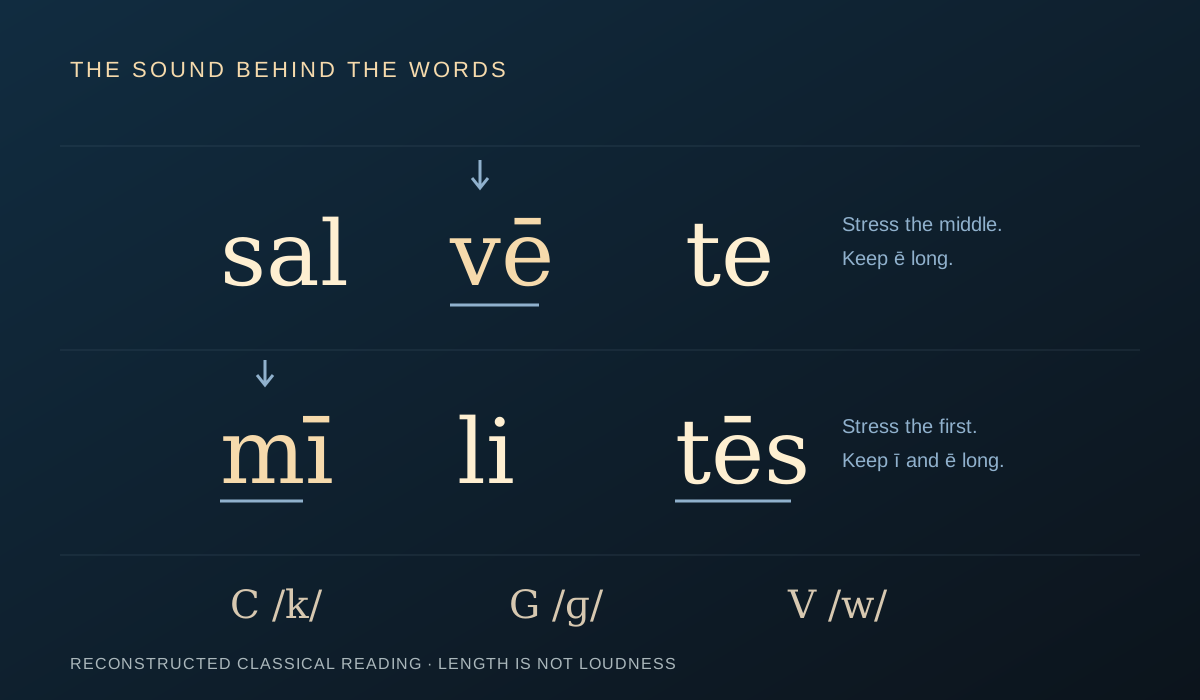
A macron tells you to sustain a vowel. It does not tell you to stress it. In Mīlitēs, the first syllable receives the stress, but the final ē remains long. Do not rush an unstressed long vowel merely because the louder part of the word has passed. [2] [3]
Two-syllable words normally stress the first syllable. Longer words stress the next-to-last syllable if it is heavy, otherwise the syllable before that. A syllable can be heavy because it closes with consonants; that does not make its vowel long. The marks on the page help preserve this distinction. [3] [4]
Six lines to read aloud
In the syllable guides, bold marks stress and a macron still marks length. The slashes enclose broad phonemic IPA: ˈ marks the stressed syllable, ː a long vowel. These are rehearsal aids, not narrow phonetic transcriptions of the characters.
Salvēte!
Greetings.
sal–vē–te
/salˈweː.te/
Address the group warmly. Let the long middle vowel have room; do not turn the final vowel into a whispered English “uh.”
Quī estis?
Who are you?
quī es–tis
/kʷiː ˈes.tis/
Keep the question conversational. The first word has a long vowel; the following word does not need to become a declaration.
Mīlitēs sumus.
We are soldiers.
mī–li–tēs su–mus
/ˈmiː.li.teːs ˈsu.mus/
Stress the opening of each word. Preserve both long vowels in the first word, including its unstressed ending.
Legiō decima.
The Tenth Legion.
le–gi–ō de–ci–ma
/ˈle.ɡi.oː ˈde.ki.ma/
Use a hard g and a k sound for c. The long final vowel in the first word does not move the stress to the end.
Hic ductus nōn erat.
This channel was not here.
hic duc–tus nōn e–rat
/hik ˈduk.tus noːn ˈe.rat/
Keep the short vowels in the first two words compact. Let the denial land without turning the line into a theatrical incantation.
Venīte.
Come.
ve–nī–te
/weˈniː.te/
Begin with a w sound in this Classical reading. It is an invitation, not a parade-ground command.
Text and meanings come from the opening chapters of Broken Arches. Guides isolate words for learning; connected speech need not preserve the little gaps used in rehearsal.
A few sounds worth keeping
For this reading convention, c stays hard, g stays hard, and consonantal v is pronounced like English w. Keep vowels clear rather than reducing unstressed endings. These small choices do more for the sound than a grand, rolling delivery. [1]
Maria’s prayer belongs to a later church tradition. Her Latin has been carried through devotion, worn familiar by repetition. Carla has learned it from books; the soldiers speak it as their own language; Maria keeps it in prayer. The same words can carry three different kinds of belonging.
KEEP EXPLORING
Sources & further reading
- Dickinson College Commentaries — Vowel and Consonant Pronunciation
Allen and Greenough §8: an approximate reconstructed Roman pronunciation and the consonants used in this guide.
- W. Sidney Allen — Vox Latina, Vowel Length
A scholarly guide to Classical Latin pronunciation; vowel length and its written representation.
- Dickinson College Commentaries — Accents
Allen and Greenough §12: word stress.
- Dickinson College Commentaries — Quantity of Syllables
Allen and Greenough §11: vowel length is not the same as syllable weight.