HISTORY & LATIN · THE READER’S COMPANION
The Rome
beneath the story.
A field of broken arches. A city built on water.
A language that still has something to say.
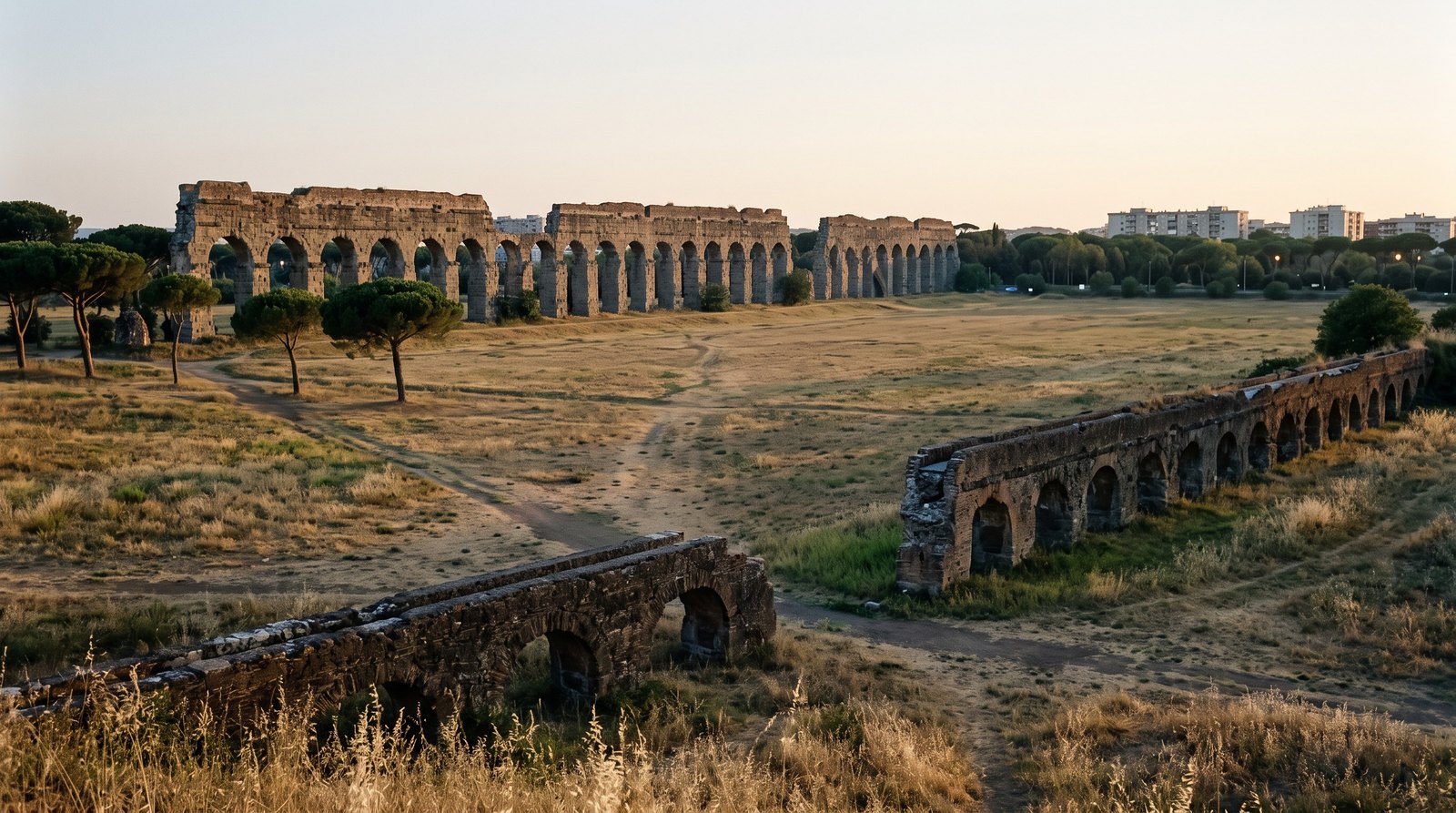
Novel illustration · an imagined view of the park in 1996
FIELD NOTES / 01
Parco degli Acquedotti
The Park of the Aqueducts.
Where the novel opens.
Before Carla hears a word of Latin, the landscape has already told her half the story. What she sees as ruins, the soldiers remember as working infrastructure. The ground is familiar. The skyline is wrong.
The real park lies in southeastern Rome, within the regional Appia Antica park. Six ancient aqueducts crossed this area; the Renaissance Acquedotto Felice makes the seventh. They were not all built at once—and seven aqueducts does not mean seven separate rows of arches. Some channels shared structures; others ran underground. [1]
READING THE LANDSCAPE
Not the same arches.
The Aqua Marcia predates the soldiers. The towering Aqua Claudia does not: work on it would begin in AD 38, eighty-one years after 44 BC. Its arches belong to a future they have never seen. [2] [3]
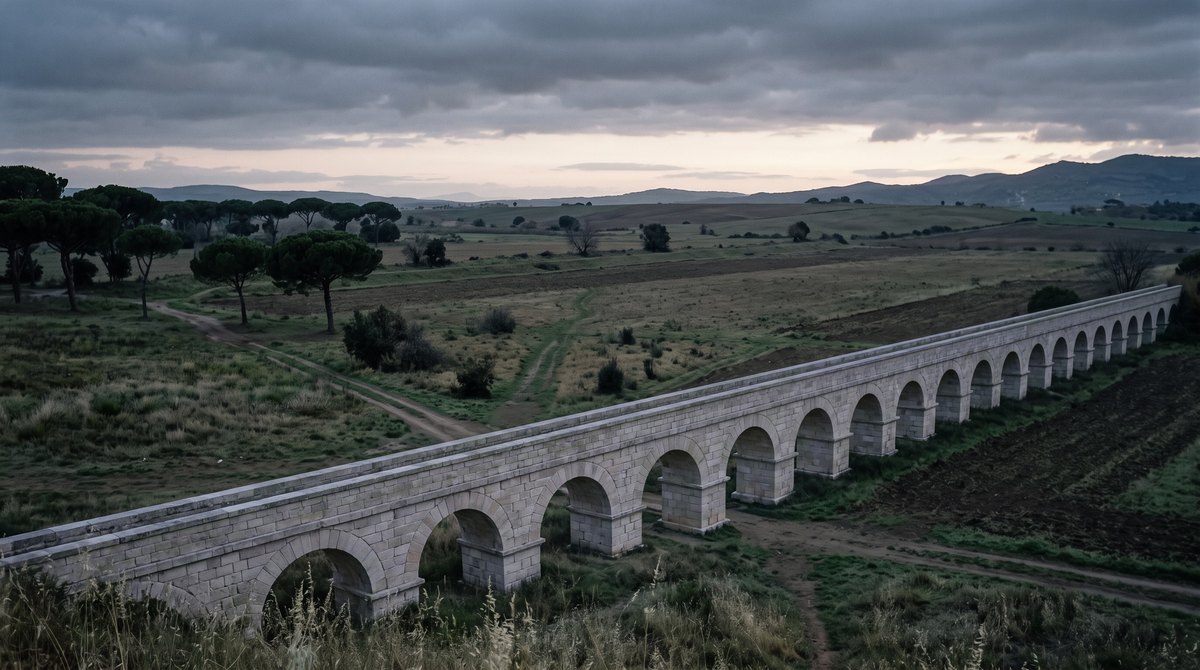 44 BC1996
These are AI-assisted illustrations made for the novel, not historical photographs or archaeological reconstructions. They convey the story’s contrast; the maps and dates below are grounded in the cited sources.
FIND YOUR BEARINGS
One city. Many layers.
Start with the park’s place in Rome, then follow the aqueduct corridors through the landscape. These original diagrams simplify geography; they are not walking maps or surveys. [1]
01 / ROME & THE PARK
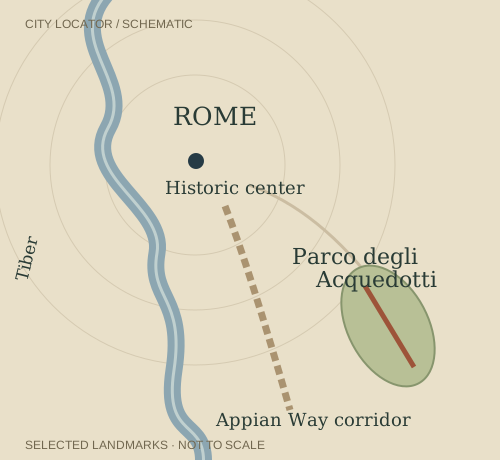
View this map larger ↗
02 / THE AQUEDUCT CORRIDORS
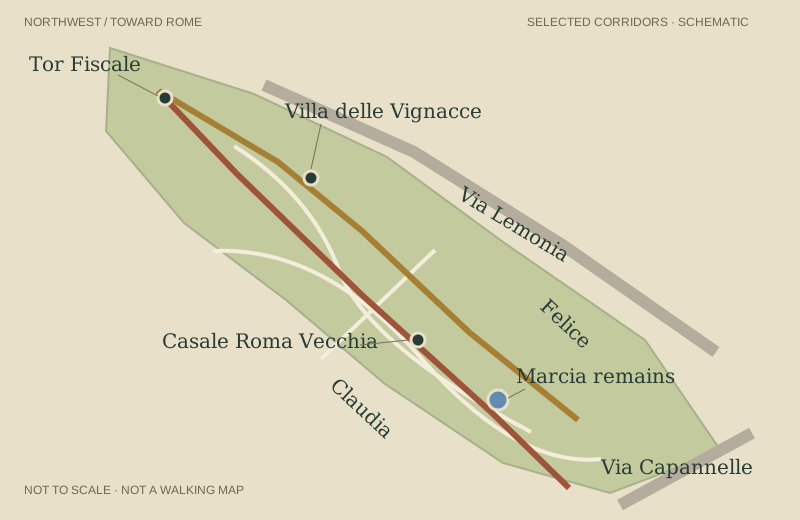
View this map larger ↗
Claudia / Anio Novus corridor
Felice corridor
Selected Marcia remains
Planning a visit? Use the official guide and the park’s current visitor information. The novel’s private houses and meeting places are not plotted here.
LOOK ABOVE THE ARCH
The water was up there.
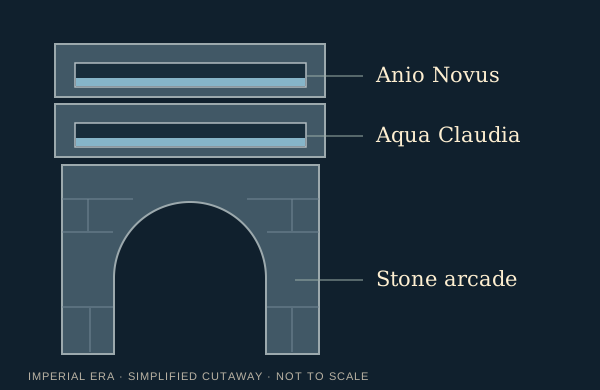
The arches supported the water channel; they were not the channel itself. A carefully controlled downhill gradient carried water toward Rome, across underground and elevated stretches. [1]
On the Claudia’s arcade, a second channel carried the Anio Novus above the Claudia. One row of arches could serve two water supplies. [3]
A LANDSCAPE BUILT OVER CENTURIES
Before the ruins.
The men have not simply missed the decay of their Rome. They have missed much of its construction.
- 272–269 BC
Anio Vetus
An early aqueduct crosses the area, largely underground. The oldest of the park’s six ancient water supplies. [1]
- 144–140 BC
- 125 BC
Aqua Tepula
A new supply from the Alban Hills. [1]
- 44 BC
THE NOVEL / THEIR ROME
Four soldiers leave on a night mission.
The Marcia already exists. The Julia, Claudia, Anio Novus, and Felice do not.
- 33 BC
- AD 38–52
Claudia & Anio Novus
Begun under Caligula and completed under Claudius. Their shared monumental arcade becomes the park’s most recognizable silhouette. [3]
- 1580s
Acquedotto Felice
Sixtus V’s new aqueduct reuses Marcia piers. Parts of the ancient arcade are dismantled: this landscape records rebuilding as well as ruin. [2]
- 1996
THE NOVEL / CARLA’S ROME
Someone answers her Latin.
For Carla, the arches have always been broken. For the men beneath them, they were whole this morning.
The historical entries describe the real aqueducts. The two highlighted entries belong to Broken Arches. This is a selected chronology, not a complete history of Rome’s water network.
WORDS FROM THE OPENING CHAPTERS
The past answers back.
You do not need Latin to read the novel. But if you want to linger over what Carla hears, begin here. These phrases are taken from the book, with their English meaning beside them.
- Salvēte!
- Greetings. Carla addresses the group. Her greeting draws an answer she was not prepared to hear.
- Quī estis?
- Who are you? A simple question. Believing the answer will be harder.
- Mīlitēs sumus.
- We are soldiers. Marcus gives her something she can translate, if not yet explain.
- Legiō decima.
- The Tenth Legion. A name Carla knows from books, spoken by a man standing in front of her.
- Hic ductus nōn erat.
- This channel was not here. The park’s layers become a contradiction the men can point to.
- Venīte.
- Come. One short word, and Carla takes responsibility for more than she understands.
KEEP EXPLORING
Sources & further reading
Historical notes and schematic maps draw on the official park publications below. Dates are modern BC/AD dates; Roman year-counting in the novel follows its own period setting.
- Parco Regionale dell’Appia Antica — I Sette Acquedotti e Tor Fiscale ↗
Official visitor map and historical guide (Italian, PDF, 2023). Locations, network overview, and the aqueduct date table.
- Parco Archeologico dell’Appia Antica — Aqua Marcia, Tepula, Iulia & Felice ↗
Official archaeological account of the older aqueducts and the reuse of Marcia piers.
- Parco Archeologico dell’Appia Antica — Acquedotto Claudio ↗
Construction dates and the Claudia / Anio Novus channels.
Latin excerpts and story references: Romans Out of Time: Broken Arches, by Roberto Campus. History is cited; fiction is labeled. This companion contains no revelations beyond the novel’s opening premise.
The city grew old—they didn’t.
READ THE FIRST CHAPTERS