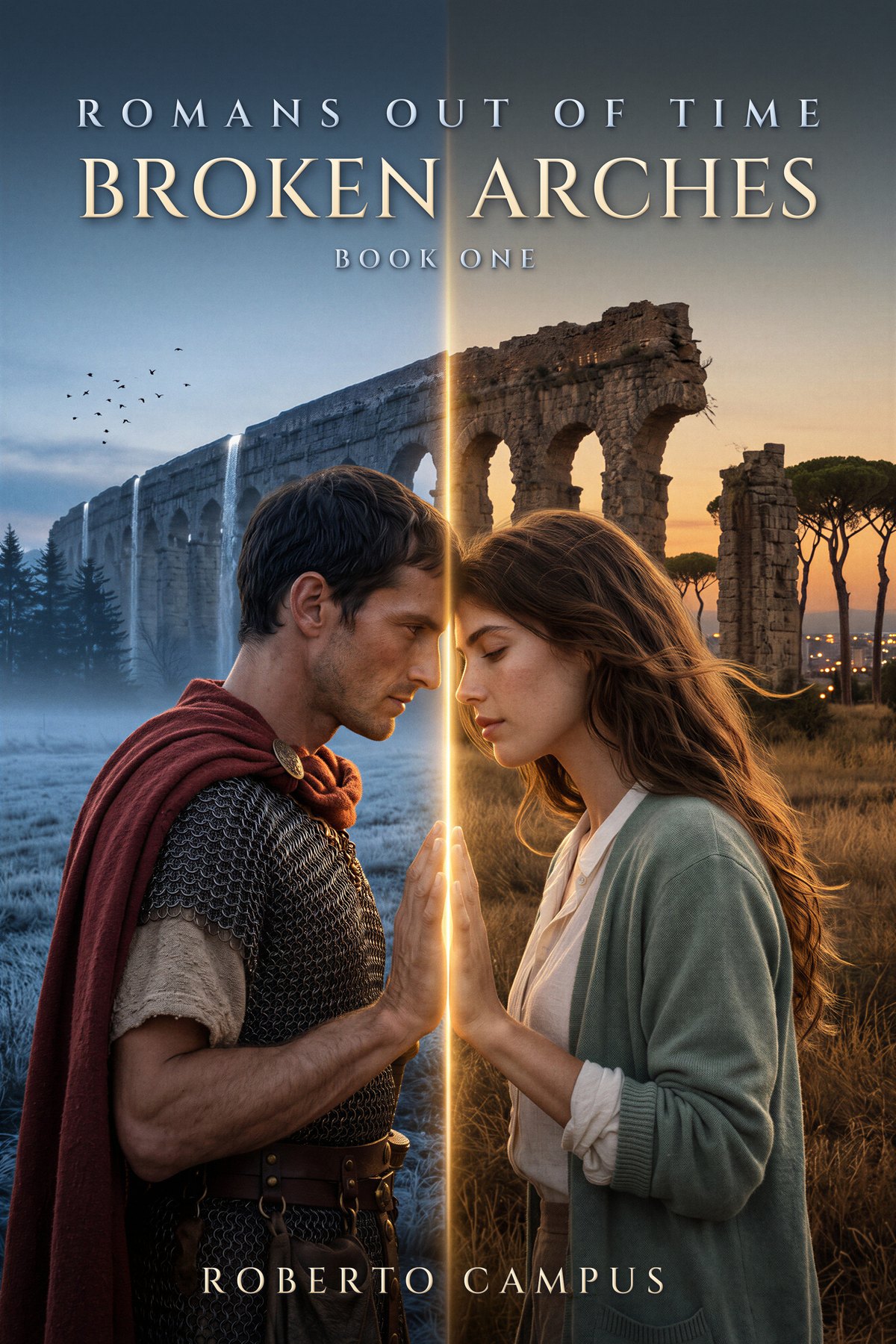
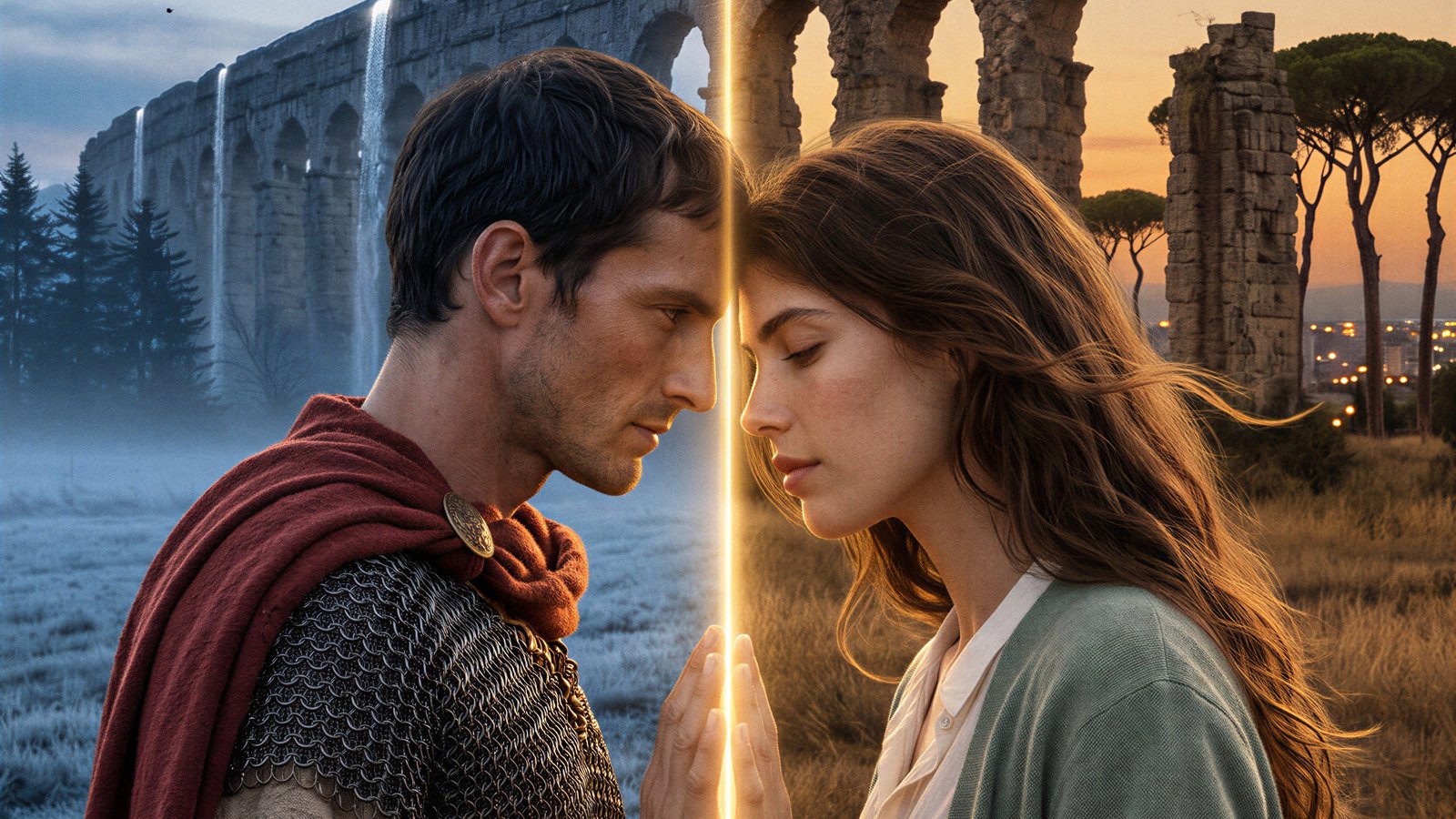
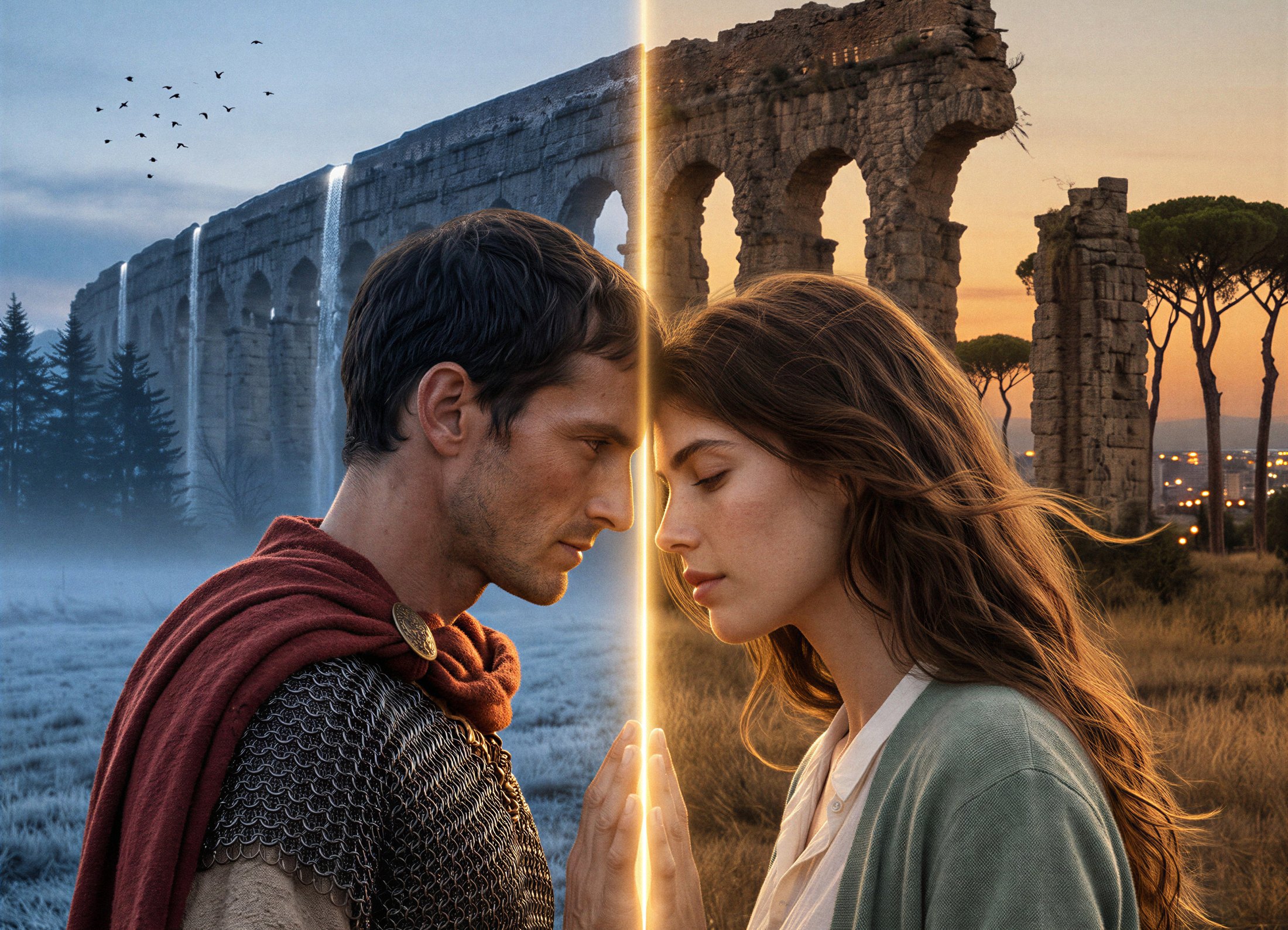
A Roman soldier and a young woman stand forehead to forehead, palms together, on either side of a line of light. Behind him an aqueduct stands whole in a cold dawn; behind her it is a ruin at dusk.
Broken Arches, Book One of Romans Out of Time, by Roberto Campus. A Roman soldier and a young woman stand forehead to forehead, palms together, on either side of a line of light. Behind him an aqueduct stands whole in a cold dawn; behind her it is a ruin at dusk.

ROMANS OUT OF TIME

Broken Arches

Book One

Love, across two thousand years. And a Rome that someone means to bring back.

Four of Caesar’s soldiers walk out of the last week of his life and into a Roman evening in 1996. One woman can speak to them. And in the old city a fire still burns that was lit against the day Rome is given back.

Venīte

Watch the Trailer

COMING SOON

The Novel

Broken Arches, Book One of Romans Out of Time, by Roberto Campus. A Roman soldier and a young woman stand forehead to forehead, palms together, on either side of a line of light. Behind him an aqueduct stands whole in a cold dawn; behind her it is a ruin at dusk.

A HISTORICAL EPIC A LOVE STORY ROME, 44 BC ROME, 1996

They left Rome before dawn.
By dusk it was two thousand years older.

Eight days before the Ides of March, four soldiers of Caesar’s guard go out by night to take a bronze thunderbolt from a household shrine. By dawn they are standing with their backs to a tomb, in the rain, and one of them is praying for the other three. The bronze grows warm. The rain goes silent. The light climbs higher than the pines.

They wake under a broken aqueduct, in a Rome that has forgotten their gods and kept their roads. The first person they meet is Carla Corvini, who has spent her life reading what men like them left behind. She speaks their language. She offers them a ride, and they vote on whether they are dead. She has a table that seats six and has been laid for one. She takes them home.

One of them carried the bronze. Marcus Sextius has given fourteen years to an oath, and believes that duty and love stand on the same side. Carla believes the past is a thing one studies. This is the story of how wrong they both are, and of what it costs to learn it under one roof.

And they are not the only ones Rome has kept waiting. Behind a plain door in the old city, the Order of the Eternal Flame has tended one fire for sixteen centuries, against the day a stolen thing is given back, and Rome with it. Every generation took that for a figure of speech. The man who leads it now does not. He has sold his family’s land. He is building. And on the plans, beside the chamber the Order calls the Gate, there is a bedroom. Asked whom it is for, he says: for whoever has to work late.

Honor, love, and the passage of time, in a city where everyone claims descent from Rome and only four men can prove it. And in the dark behind the tombs, something that has been paying attention all along.

BUY THE EBOOKComing soon
The Characters

She has spent her life studying the past.
He walked out of it this morning.

A historian who has always chosen the record. A soldier who has always done what he was ordered. On the same day, each of them makes an exception.

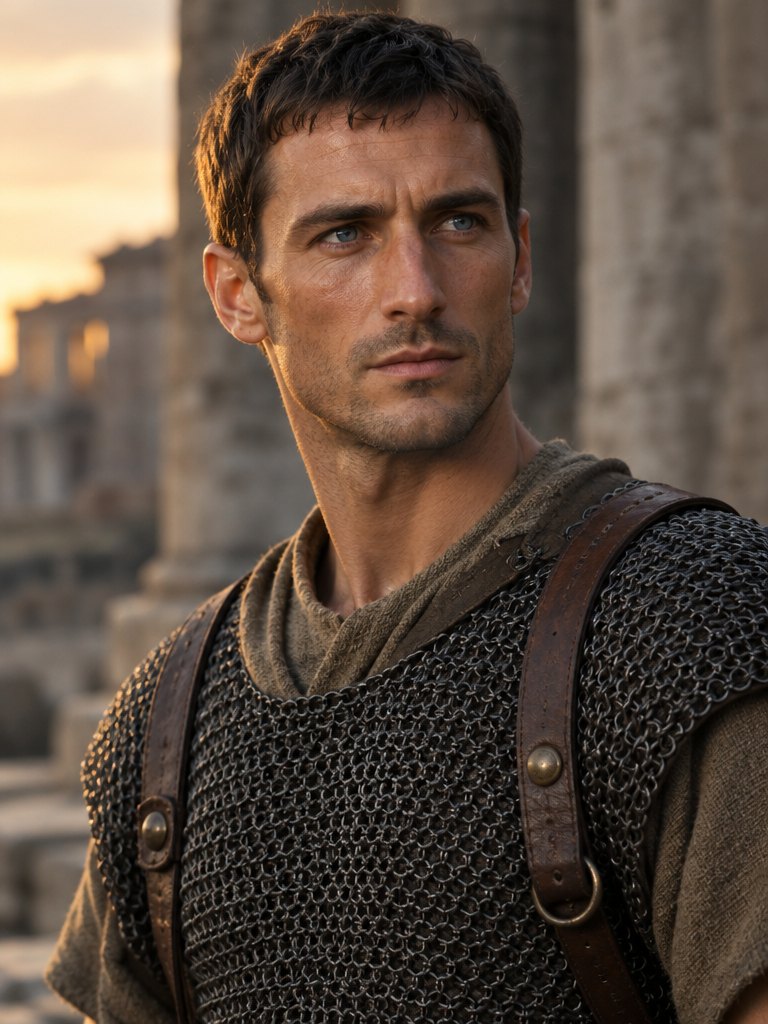
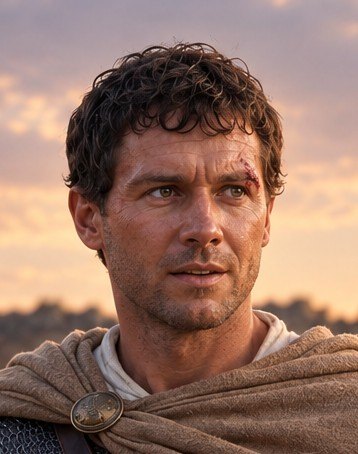
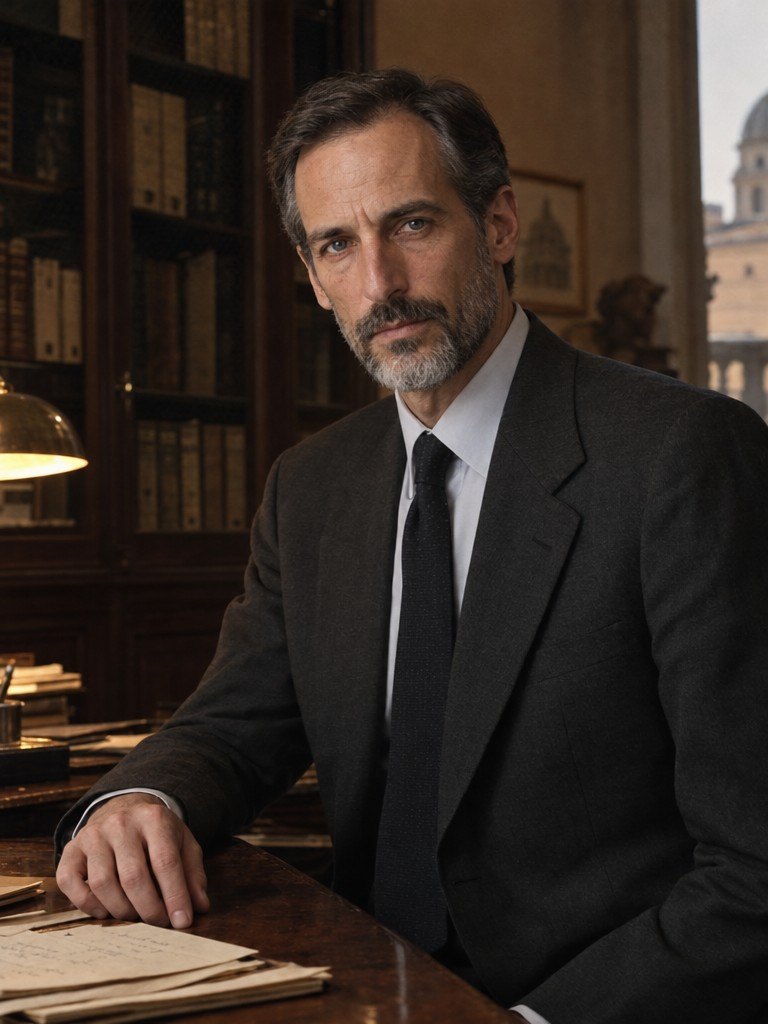
Marcus Sextius in mail, his eyes turned to something beyond the frame

THE SOLDIER

Marcus Sextius

Fourteen years in Caesar’s Tenth Legion, from a Sabine farm that could not carry two sons. Ordered to take the bronze and run, he stayed with his men. He was holding it when the light came through his fingers. He has an oath to a man he cannot reach, and he watches her hands.

Carla Corvini on a path beside an aqueduct, in a white blouse and a sage cardigan

THE HISTORIAN

Carla Corvini

Twenty-seven, five months out of her doctorate, with one year’s grant to study how Rome brought in its water. She has two Latins: the one her uncle taught her at the kitchen table, and the one her aunt says over the sink. She has spent her life among this city’s dead, and until one August evening none of them had answered.

THE TABLE SEATS SIX

For some years it had been asked to seat one.

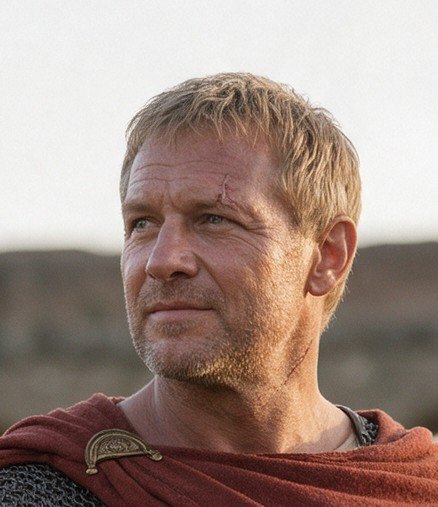
Flavius, blond and weathered, looking off to one side
THE COMMANDER

Flavius

Twenty-five years a soldier, with a sword worn bright where his hand rests on it. Whenever the four come back together he counts the other three by name, always in the same order. Into anything unknown, he goes first.

Quintus Fabricius, dark-haired and broad-faced, against an evening sky
THE MASON

Quintus Fabricius

A mason from a family of masons, who can tell good lime from bad between finger and thumb. He has a wife, a son, and a daughter who learned to walk on the first of the month. At the broken aqueduct he cups a hand behind his ear, sure he has heard water.

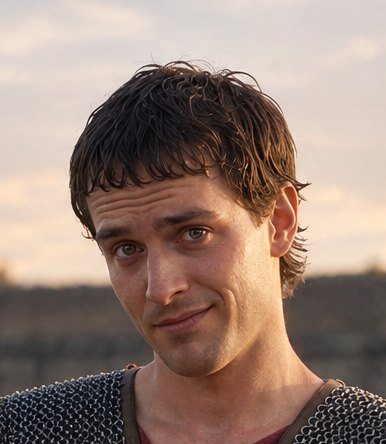
Publius Decius, the youngest, with a quick half-smile
THE YOUNGEST

Publius Decius

Placed among veterans with a Greek education and no campaigns. He meets everything as a question for discussion: whether they are dead, whether she is a witch, whether the poets lied. When she offers them supper, the comparison he reaches for is Circe.

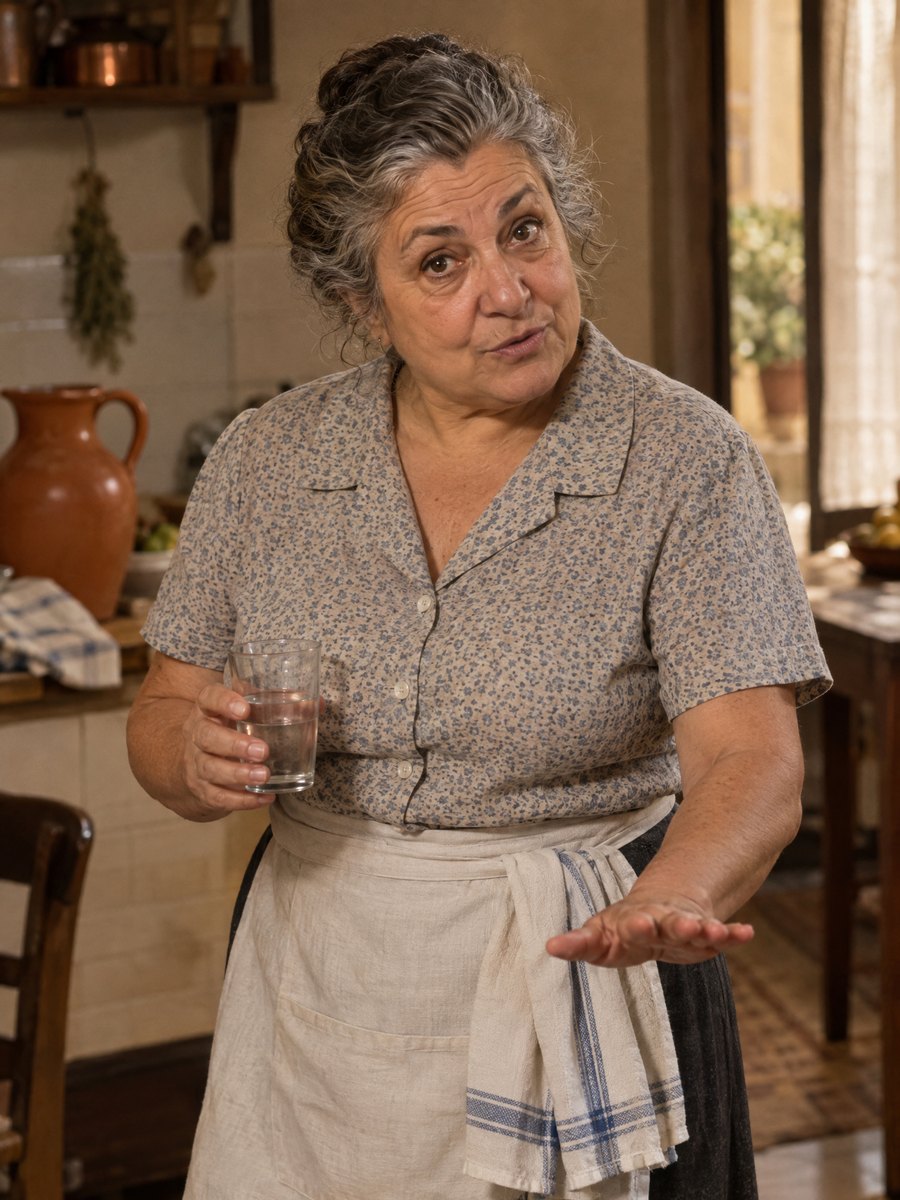
Maria Corvini in her kitchen, a glass in one hand and the other held out mid-argument
THE AUNT

Maria Corvini

She raised Carla, and can tell from three streets away when her niece is eating standing up. Her only Latin is the rosary’s. “They needed water,” Carla tells her. “So do the geraniums. I leave those outside.”

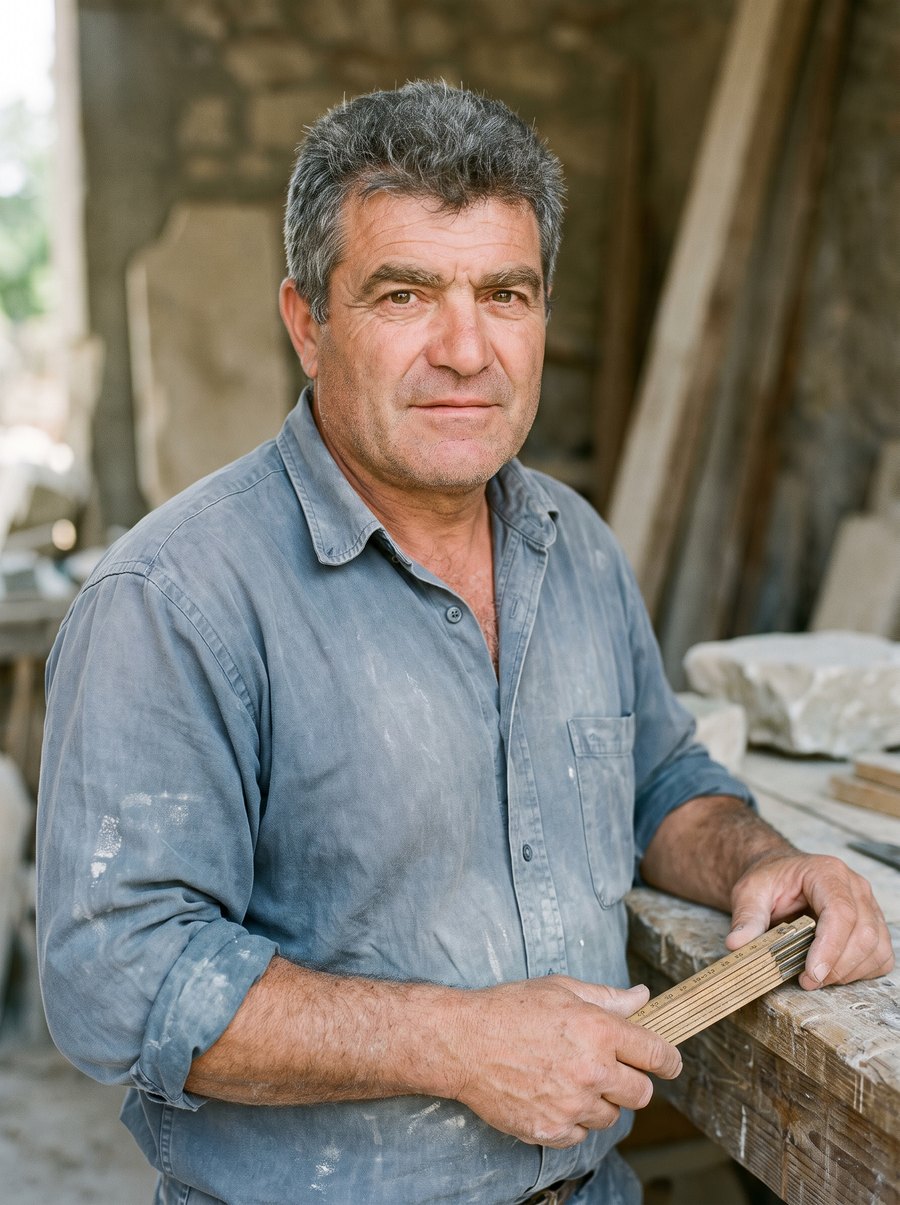
Luca Proietti at his workbench in a dusty blue work shirt, a folding ruler in his hands
THE BUILDER

Luca Proietti

He runs a restoration firm alone, out of a van that still reads PROIETTI E FIGLI, though the sons went north. He knows no Latin and has no use for gods. Maria tells him the four men are Romanian and need work.

THE ORDER OF THE ETERNAL FLAME

“What has been carried off can be fetched back.”

Gabriel Castelvecchio at a desk in a private archive, in a charcoal suit, one hand on the papers
THE LEADER

Gabriel Castelvecchio

At nineteen he read one Latin word and was given a date and an hour, the way a man is given his own name. Every eighth of March since, he has walked the Appian Way before dawn and asked the road for what it took. He has sold his family’s land to stop asking.

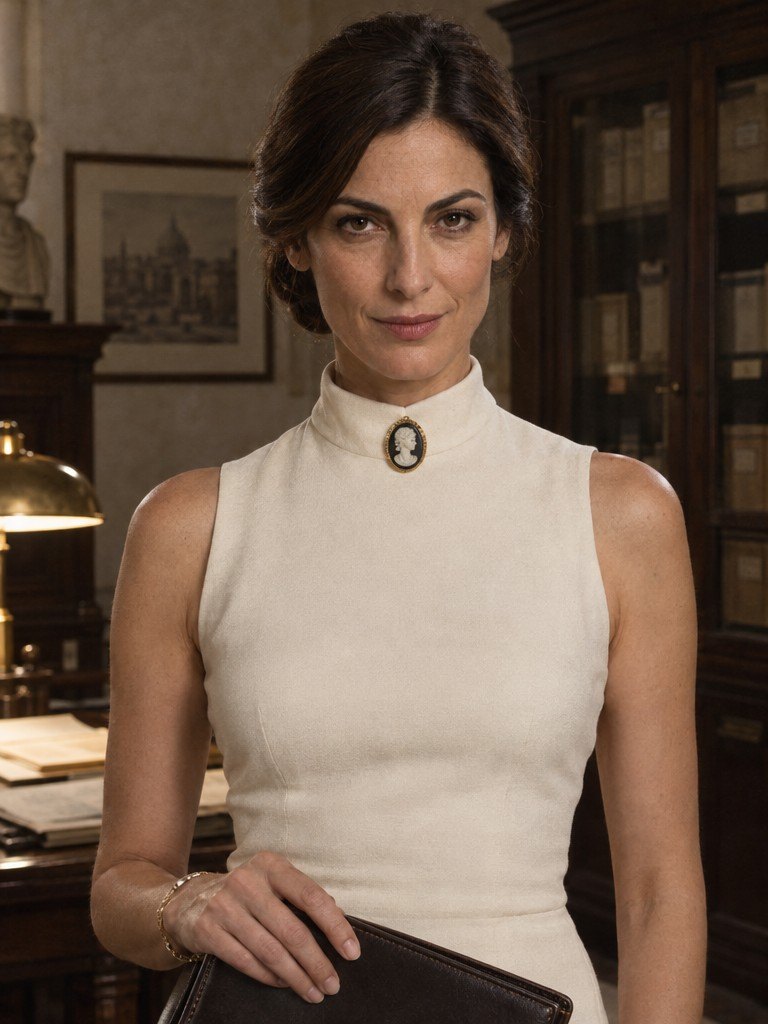
Claudia DeOrsi in a cream dress with a cameo at her throat, one hand on a leather folio
THE HEIR

Claudia DeOrsi

She wears at her throat the face of the emperor she calls her ancestor, and carries her family’s oldest drawing into the Order’s house with her own hands. She left Gabriel the winter the council gave him money. She has come back to see what he spends it on.

A man’s figure in deep shadow, his face unreadable
THE GUEST

Name withheld

There is a bedroom on the Order’s plans. Asked whom it is for, its leader says: for whoever has to work late. The timetable in his cabinet ends in a date and an hour. No one else has seen it.

The World

The same field.
Two thousand years apart.

The ground, the objects and the languages the story stands on.

I

The Aqueducts

The Aqua Marcia was old when Caesar was born. The Claudia, whose arches stand over it, was not begun until eighty years after he died. One of the four lays his palm on a pier of the Claudia, at the height of his shoulder, where that morning he crossed an open field.

II

The Fulmen

Latin for thunderbolt: a bronze one with a serpent coiled around it, small enough for one hand. Whoever set it in its shrine fixed it there with lead, so that it could not be carried out with the other household gods. Caesar wanted it before first light and did not say what it was for.

III

The Latin

The soldiers speak the Latin of Caesar’s Rome, and the book prints what they say with the meaning beside it. Carla has read the language all her life and never heard it run one word into the next. Her aunt has a Latin too, worn smooth by the rosary. She has no idea she is holding the end of their language.

IV

Rome, 1996

A Fiat Uno with two wheels on the curb. A jet coming in low toward Ciampino. An evening bus, lit, with forty people standing and nobody speaking. To the four men each is evidence, and they weigh it with care. So far it supports two conclusions: they are dead, or a god is deceiving them.

V

The Gate

Under the Order’s house, in cellars of wet tufa where a lamp’s light goes a yard before the dark has it back, a chamber is being cut. What will stand in it is a ring of bronze, cast from a drawing one family has guarded through wars and sales, and fed with the power of a city. On the drawing, one line does not close. On the Order’s copy, it does.

The Companion Album

COMING SOON

Broken Arches, Book One of Romans Out of Time, by Roberto Campus. A Roman soldier and a young woman stand forehead to forehead, palms together, on either side of a line of light. Behind him an aqueduct stands whole in a cold dawn; behind her it is a ruin at dusk.

THE FIRST THREE CHAPTERS

Read the First Chapters

Start at the aqueduct,
on an evening in late August.

Sign up for Letters from the Aqueduct: occasional letters from the author, and the first three chapters free.

No spam. Unsubscribe anytime. The first three chapters arrive immediately.
Roberto Campus

About the Author

Roberto Campus

Born in Sardinia in 1974, Roberto is an illustrator, orchestral composer, software architect, and theoretical physicist. His work for Marvel, DC, LucasArts, and Star Trek sits beside a lifelong inquiry into structure, beauty, and the geometry beneath reality.

He grew up near Rome, where Broken Arches is set. His first novel, The Violet Engine, is out now.