“Seven” sounds like an uncomplicated answer until one man means a number on a clock and another thinks of the sun. A shared appointment needs more than a shared vocabulary.
An hour could change its length
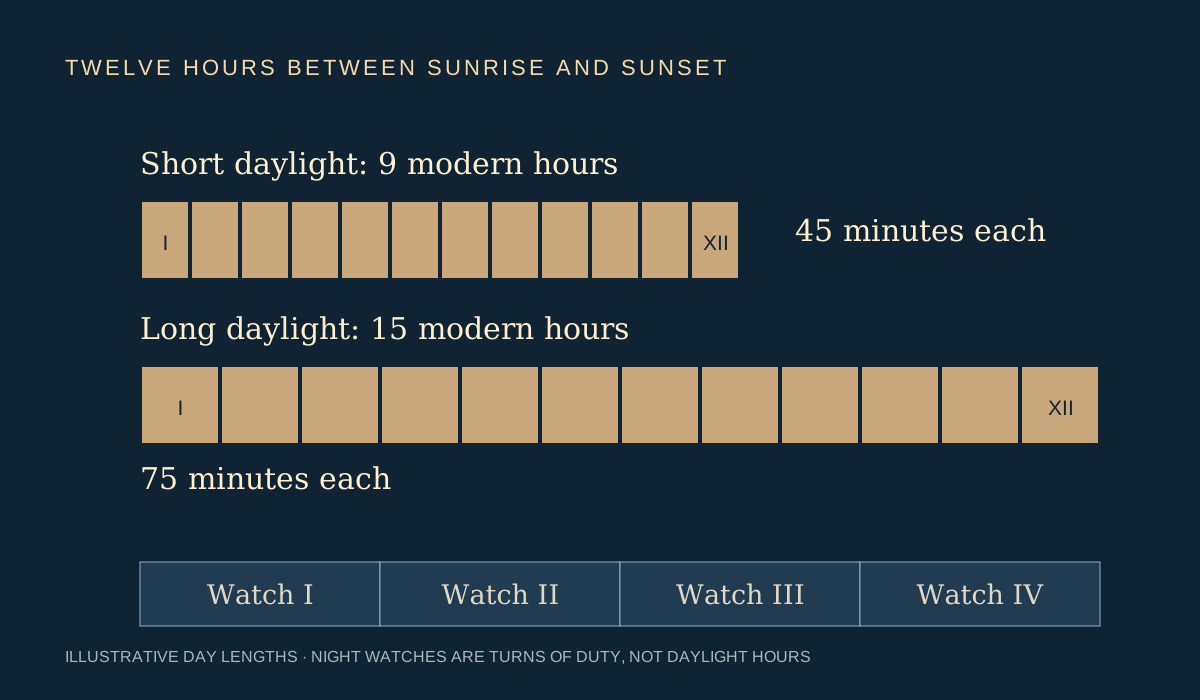
In a common ancient system, sunrise to sunset was divided into twelve hours. A summer daylight hour therefore lasted longer than a winter one. Noon lay at the division between the sixth and seventh hours. A clock whose hours remain sixty minutes is not simply an ancient dial with better machinery. [1]
Sundials could use the sun’s shadow to indicate these divisions. The surviving portable instrument discussed by Oxford’s History of Science Museum requires settings for latitude and season; adjusting it to place and time was part of using it. This instrument belongs to the wider Roman and Byzantine history of measurement. [1]
Twelve hours, however long the day
Change the daylight span. The divisions remain twelve; the duration of each changes.
One seasonal daylight hour =
Educational model: daylight minutes divided by twelve. These examples are not historical sunrise times or a clock-time conversion for a particular date. With scripts off, the twelve-hour-day example remains visible.
A soldier’s night
A watch is a turn of duty, not another name for a daylight hour. Polybius describes four successive night watches, patrols, and the sounding of a signal at each change. His account records the organization of an earlier Republican army. [2]
In the novel, departure in the third watch and an appointment in the fourth allow the men to distinguish stages of the night. “Before dawn” gives an operational limit. Neither expression demands that they look down at a wristwatch.
Eight days before the Ides
Roman dates commonly counted backward to the next Kalends, Nones, or Ides, including both ends of the count. The Ides fall on March 15. Counting March 8 and March 15 gives eight days—not the seven elapsed days a modern reader might subtract. [3]
This is why the book’s Roman heading can say “eight days before the Ides of March” while placing the mission on March 8. The heading’s year 710 locates the mission using the traditional count from the founding of the city. The date places the reader inside the men’s reckoning before the first order is given.
Caesar changed the calendar, too
Suetonius describes Caesar replacing the disorderly intercalation system with a solar year of 365 days and provision for an additional day every fourth year. In the soldiers’ 44 BC, the Julian reform was new. A modern AD year would not be their natural frame of reference. [4]
Carla’s problem is therefore not solved by writing “1996” in large numerals. She needs to explain an interval and an unfamiliar reckoning. Learning the new world includes learning what its numbers mean.
KEEP EXPLORING
Sources & further reading
- Oxford History of Science Museum — Roman Portable Sundial
Stephen Johnston’s explanation of seasonal hours and the operation of a surviving vertical disc dial.
- Polybius — Histories 6.35–36
An earlier Republican account of camp patrols and four night watches, in W. R. Paton’s translation.
- Encyclopaedia Romana — The Julian Calendar
Calendar landmarks and inclusive counting, with references to ancient evidence.
- Suetonius — Julius Caesar 40
The later biographer’s account of Caesar’s calendar reform, in J. C. Rolfe’s translation.