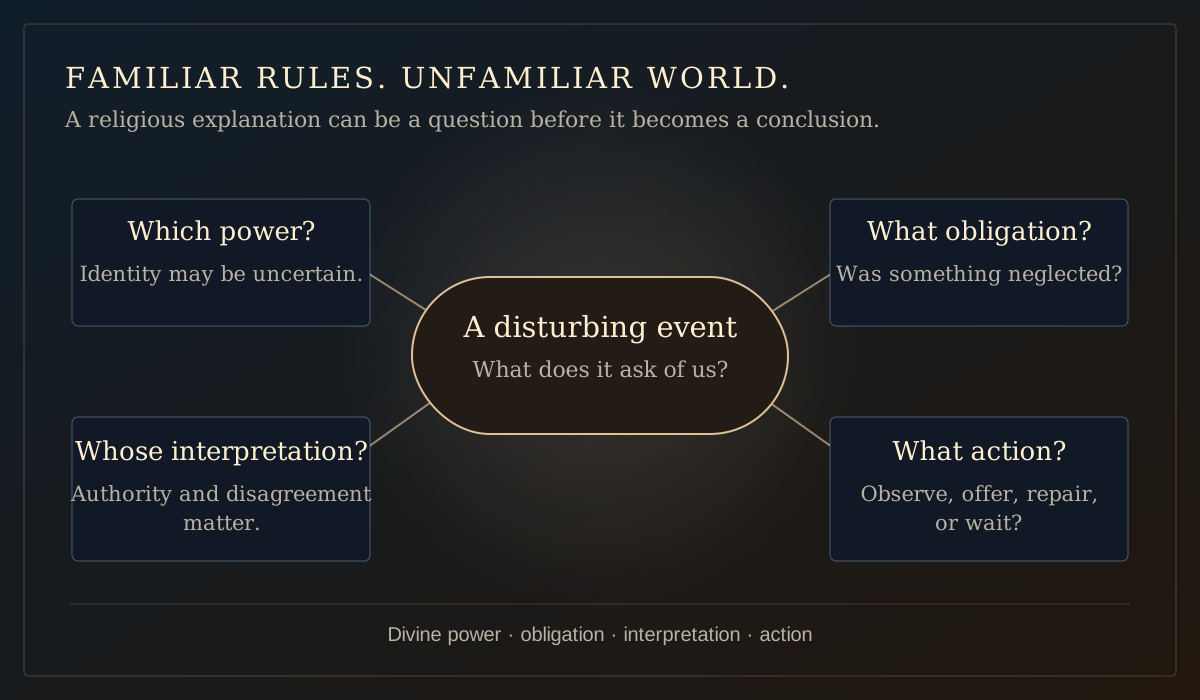
The men can build a wall and still fear a sign. Practical skill and religious observance do not cancel one another. An unfamiliar world may call for new explanations—but they begin with the explanations they already possess.
Belief belongs in the world, not outside it
Roman religion involved multiple gods, inherited rites, and traditions absorbed through contact with other peoples. There was no single book that supplied every Roman with one identical theology. Worship could concern household, field, city, and public office, not only a person’s private conviction. [1]
That matters when reading the soldiers. To ask whether a god has intervened is not, for them, to step out of serious life. It is to ask what kind of situation they are in—and what responsibilities follow.
Do the work. Observe the rite.
Cato’s agricultural handbook places exact practical instructions alongside religious ones. Before thinning a sacred grove, he prescribes an offering and a prayer that allows for uncertainty about the deity’s identity. His purification rite asks Mars to protect household, crops, and animals; it also provides a response if an offering is not accepted. [2]
The juxtaposition is instructive. A farmer need not choose between a sharp tool and proper observance. Ritual belongs to the work. It identifies whom the action concerns, asks permission or assistance, and attends to a possible fault.
A sign needs an interpreter
Cicero’s On Divination distinguishes methods based on learned interpretation from dreams and inspired states. Its speakers discuss birds, lightning, unusual occurrences, and warnings encountered in sleep. These categories were debated, not one undifferentiated heap of magic. [3]
Auspices
Formal consultation of signs could concern whether public action should proceed. Seeing a bird on a walk was not automatically the same thing as an authorized public consultation. [4]
Unusual events
A disturbing occurrence could raise a question of divine displeasure and require interpretation or a religious response. Cicero records the place such practices held in Roman public life. [3]
Dreams
The dialogue treats dreams as a separate kind of possible warning. Their meaning and reliability still required argument. A vivid dream was not a universally accepted instruction. [3]
Romans argued about it too
Cicero gives his brother a defense of divination, then subjects it to a skeptical examination. His own speaker can defend inherited civic practice while questioning its claim to predict the future. For him, the authority of inherited practice and the reliability of a prediction are separate questions. [3] [4]
Even a chicken’s appetite could carry formal significance. Cicero describes feeding birds and a favorable result announced when food fell to the ground—then attacks the manipulation involved. He also describes changes in field practice during his own age: observance had a history, and Romans argued over its use. [4]
The humor is already in the evidence. So is the seriousness: an argument about signs could also be an argument about the authority to act.
A small object with public weight
A gold coin dated 46 BC in the British Museum shows a curved augural staff, a jug, and an axe. Religious implements belonged on public money, not only inside temples. These symbols could make religious office visible in an object passed from hand to hand. [5]
Religious authority traveled with the coin. A sign of sacred office could also be a declaration of public standing: divine obligation and civic power occupied the same small piece of gold.
Four responses to the same fear
In the novel, Marcus looks for an obligation fulfilled or neglected. Flavius preserves observance as something he can still do. Quintus’s longing for home changes the emotional weight of any explanation. Publius can reason, speculate, and joke without abandoning the men’s religious frame.
The prospect of divine judgment makes action urgent. A neglected obligation calls for repair; a command still binds; the men beside you still need protection. They can fear a god’s anger and keep their hands steady. Their piety gives responsibility a reach beyond whatever happens to be convenient.
That is where belief becomes dramatic: in the next choice, the rite observed under pressure, the promise kept when nobody can enforce it. What do the men owe—and what will they do to honor it?
KEEP EXPLORING
Sources & further reading
- Penn Museum · Roman Religion
An institutional introduction to the variety and development of Roman religious traditions.
- Cato · On Agriculture 139–141
Rites before work in a sacred grove and the purification of a farm; an earlier Republican source.
- Cicero · On Divination, Book I
The dialogue’s defense of divination, its categories, and disagreement between philosophical schools.
- Cicero · On Divination, Book II
The skeptical response; sections 72–77 distinguish inherited augural practice from contemporary field use.
- British Museum · Aureus with religious implements, 46 BC
Museum number R.8949: the reverse depicts an augural staff, jug, and axe.