A Roman soldier is easy to recognize on a movie poster. Recognizing a soldier of 44 BC takes more care: a different army, uneven evidence, and men who spent as much time making a place defensible as fighting for it.
Start with the right century
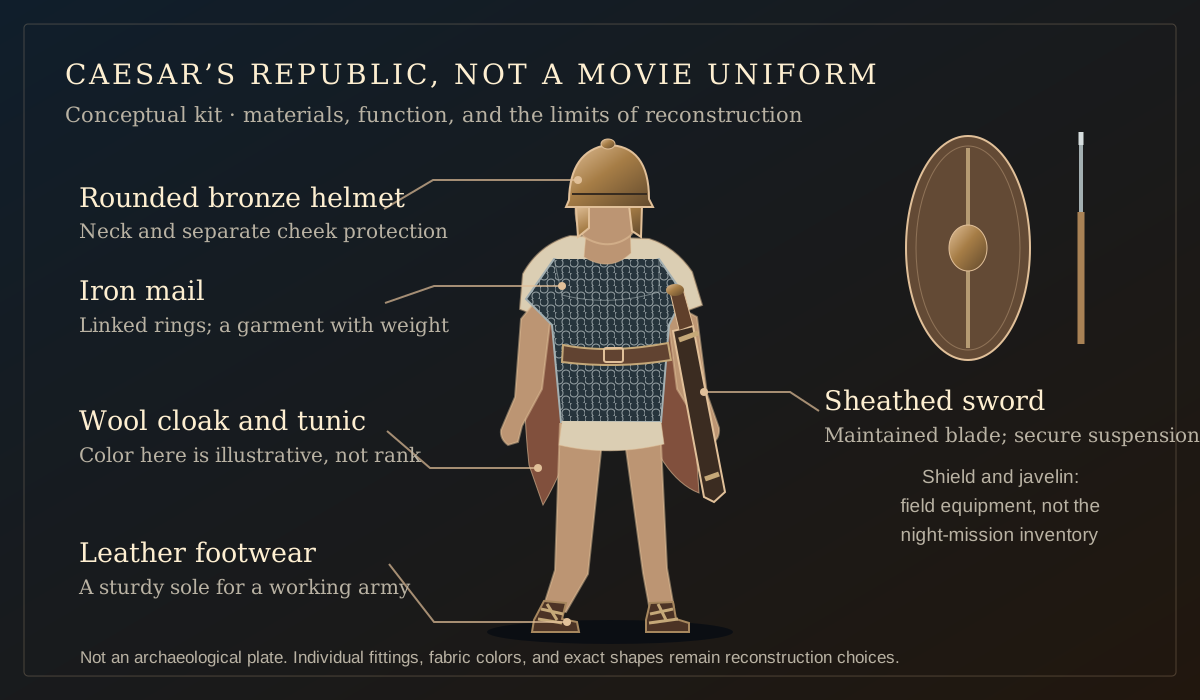
The four men belong to Caesar’s Republic, not the later imperial army familiar from monuments and films. Mail, wool, bronze, and leather give them a working silhouette. Their equipment belongs to a Republican army, with its own history of forms, materials, and practical demands.
Polybius describes an earlier Republican army, including mail for wealthier infantrymen, helmets, shields, and javelins. His account is valuable background, but his second-century BC organization cannot be copied unchanged into 44 BC. [1]
What the equipment tells us
The helmet
A rounded bronze bowl, neck protection, and separate cheek pieces follow Republican examples. The British Museum’s Montefortino-type specimen is dated 300–100 BC: evidence for the earlier family of forms, not this fictional helmet’s exact date. [2]
The mail
Interlinked rings make a flexible metal garment. Weight, fastening, and maintenance matter more than a shiny silhouette. Polybius already records mail well before Caesar’s final years. [1]
The blade and the hands
A sword is equipment to maintain, not a prop to flourish in every conversation. In the novel, worn grips, careful handling, and restrained fittings make ownership visible without inventing a regulation for each detail.
The cloak and the road
Wool and leather supply much of the silhouette. Cloak colors distinguish these characters; they are not a color chart of late-Republican ranks. The same applies to a small neck cloth: a cautious design choice, not proven standard issue.
Good equipment need not be crude. Suetonius says Caesar supplied silver- and gold-inlaid arms, associating their value with his soldiers’ attachment to them. A veteran’s equipment can be valuable, well maintained, and marked by years of use at the same time. [3]
Four men, not one uniform
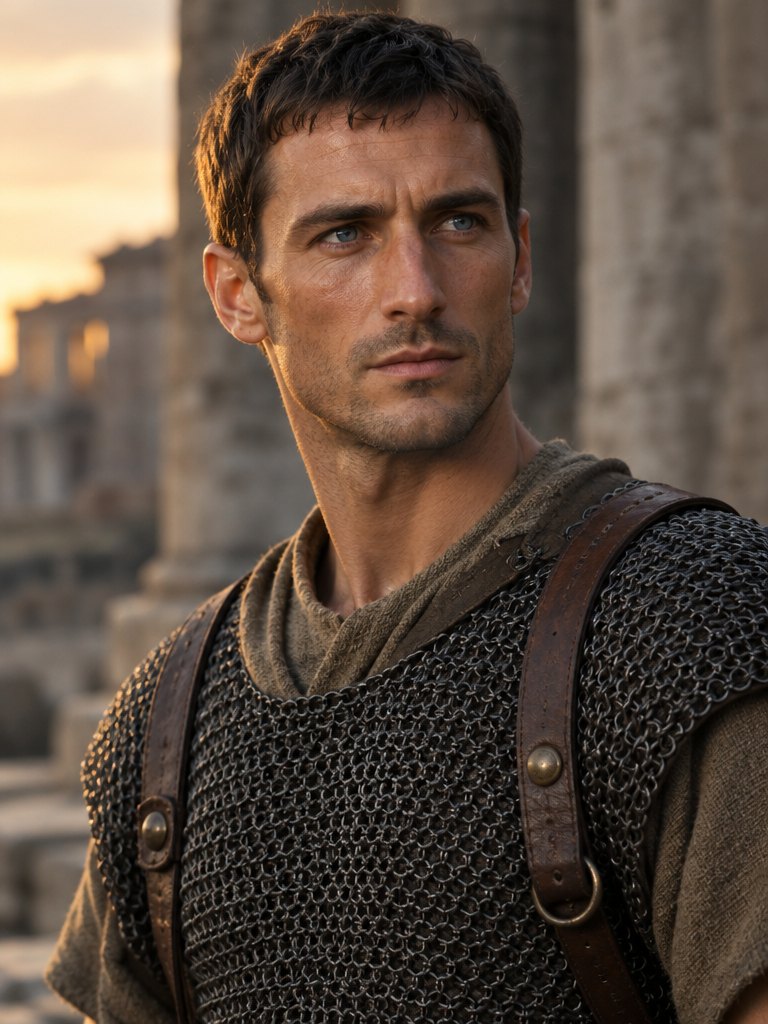
Marcus Sextius
Brick-red wool, restrained silver-inlaid sword fittings, and a small belt bag. His distinction lies in attention: the next hand, the next doorway, the task still unfinished.
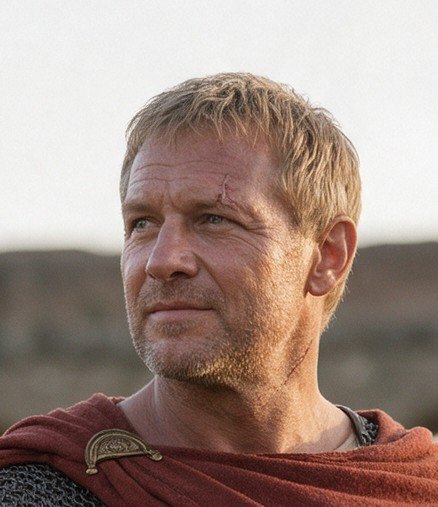
Flavius
Dark russet, old polished fittings, a weathered crest, and silver award bracelets. He commands the detail; his precise formal rank remains unassigned. His crest is a reconstruction, not proof of a universal 44 BC rank badge.
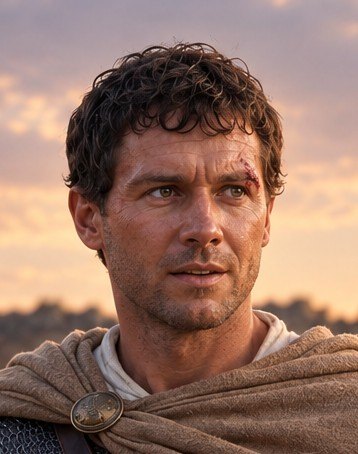
Quintus Fabricius
Undyed brown wool, a diagonal sword strap, a working knife, and a small neck cloth. His clothes must leave room for the craftsman as well as the soldier.
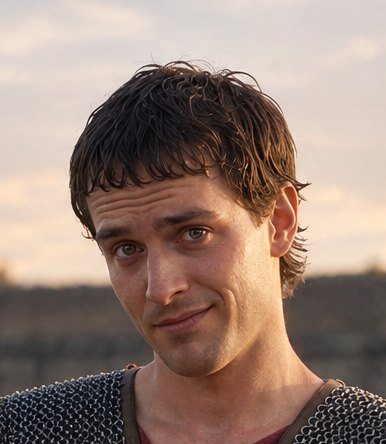
Publius Decius
A cream cloak over muted red, a family signet, and finer personal equipment. Wealth and influence can furnish a newcomer. They cannot furnish him with a veteran’s experience.
These portraits are AI-assisted character illustrations from the novel, not historical likenesses. Flavius’s bracelets represent earned honors, not protective wrist armor. Pliny records bracelet awards in Roman military tradition; the specific pair and its owner are fictional. [4]
The army that carried tools
Military competence could mean laying out a camp, handling timber, moving earth, and working under coordinated instructions. Polybius describes measured camp arrangements; Caesar’s account of his Rhine bridge specifies timber, piles, braces, and protective works. [1] [5]
The four men bring different strengths to practical work: Quintus’s knowledge, Marcus’s care, Flavius’s organization, and Publius’s quick mind without a veteran’s experience. A workshop can expose their differences as quickly as a fight.
On a compact night mission, the load follows the task. These men need to move, climb, and act together; parade display and a marching column’s full equipment would get in their way.
Gesture and command
The novel’s breast-to-forward military courtesy is a fictional convention drawn from screen portrayals, rather than an attested standardized ancient salute. It gives the encounter with Luca a visible clash of manners.
The most persuasive signs of command are often less decorative: who waits, who answers, and whose short instruction the others obey.
KEEP EXPLORING
Sources & further reading
- Polybius · Histories, Book VI
Sections 23–24 and 27–32: earlier Republican equipment, leadership, and measured camps. Not a direct 44 BC uniform manual.
- British Museum · Montefortino-type bronze helmet
Museum number 1867,0508.202; dated 300–100 BC. The catalog records neck protection and original cheek pieces.
- Suetonius · Julius Caesar 67.2
An ancient literary account of decorated arms and Caesar’s relationship with his soldiers.
- Pliny · Natural History 33
Section 37 records military bracelet awards; it does not identify Flavius’s fictional pair.
- Caesar · Gallic War, Book IV
Sections 17–18 describe construction of the Rhine bridge. Caesar is a participant and a self-interested narrator.