A wall can be a more eloquent witness than a speech. Roman builders left materials we are still learning to understand—and reasons to look carefully before calling an old method primitive.
What holds a Roman wall together
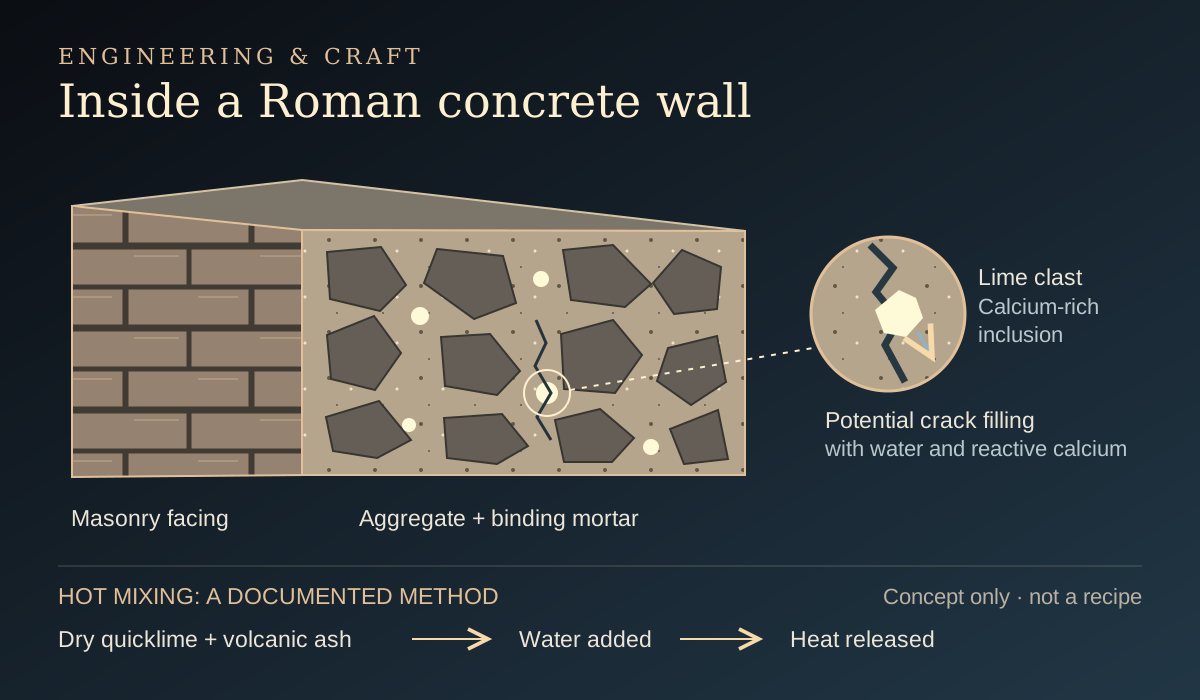
The distinctions matter. A binder holds a mixture together. Mortar is the binding mixture used between or around pieces of masonry. Roman concrete combines a mortar with larger fragments of stone or other aggregate; it is not simply an enormous block of cement. Facing can conceal a substantial core of this material. The Pompeii researchers describe mortar and larger stone pieces as complementary parts of a construction process. [1]
Lime and suitable volcanic material are important ingredients in many durable Roman examples. Pozzolana is a name associated with reactive volcanic ash; not every handful of ash, sand, or local dirt is interchangeable. Vitruvius discusses different sands, stones, and their behavior in different uses. He also describes volcanic material that allows lime-and-rubble construction to harden underwater. His explanations are ancient, not modern chemistry, but his attention to selection is unmistakable. [2]
The white flecks were worth another look
In a 2023 study, researchers investigated calcium-rich inclusions called lime clasts. They found evidence for hot mixing: quicklime used with, or instead of, previously slaked lime. Their Roman-inspired test materials demonstrated a capacity to fill cracks. The inclusions could supply reactive calcium as water moved through the material, rather than being dismissed as meaningless imperfections. [3]
A 2025 study supplied a remarkable archaeological connection. A construction site preserved at Pompeii by the AD 79 eruption contained quicklime already mixed with dry volcanic material. Adding water to such a mixture releases heat. Here, researchers could study preparation material alongside unfinished and completed masonry—not merely infer a workflow from the finished wall. This is evidence from a particular Imperial-period worksite, not proof that every builder in 44 BC followed an identical procedure. [1]
A harbor tells a different chemical story
Marine concrete needs its own explanation. Research on ancient piers and breakwaters identified continuing mineral growth as seawater entered the concrete. Aluminous tobermorite and phillipsite helped reinforce the binding matrix. That is not simply the same process as a calcium-rich inclusion filling a crack in terrestrial mortar. Different materials and environments can support different routes to durability. [4]
The sea, in these examples, participates in the material’s long history. A garden wall does not become a Roman harbor by receiving a bucket of salt water.
The craft behind endurance
Endurance begins with material judgment. Vitruvius warns about unsuitable materials and masonry that decays; the survival of a Roman wall is an achievement, not an automatic property of its age. [2] Load, reinforcement, and exposure determine what a structure needs. A durable mix must suit the work it is asked to do.
In Broken Arches, craft carries a moral weight. Quintus works toward a wall that will hold, not merely a job that will pay. His knowledge meets Carla’s scholarship and Luca’s eye for sound work. Selection, proportion, and patience become a standard against which haste and extraction can be judged. The argument stands in the finished masonry.
Two clocks for the reader
This essay includes research published in 2023 and 2025. Carla lives in 1996. She can know Roman materials through the evidence and scholarship available then; she cannot already know these later findings. The modern research illuminates the book for us, not retrospectively for her.
Quicklime is caustic, and its reaction with water releases substantial heat. The diagram explains a process; it is not a mixing recipe.
KEEP EXPLORING
Sources & further reading
- Vaserman and colleagues: An unfinished Pompeian construction site reveals ancient Roman building technology (2025)
Primary research in Nature Communications on raw material piles, hot mixing, masonry components, and the AD 79 construction context.
- Vitruvius: On Architecture, Book II
An ancient witness to material selection, lime, volcanic material, and the limitations of masonry. His treatise is not treated as a universal Roman recipe or a book the soldiers had read.
- Seymour and colleagues: Hot mixing—mechanistic insights into the durability of ancient Roman concrete (2023)
Primary Science Advances study of lime clasts and self-healing behavior in Roman-inspired experimental materials; open-access record at MIT.
- Lawrence Berkeley National Laboratory: Concrete resilience in seawater (2017)
Research-facility account of marine mineral growth, with a link to Jackson and colleagues’ underlying American Mineralogist paper.