A Roman soldier does not need a modern host to explain that dirt is unpleasant. He may, however, have questions about the equipment, the locked door, and why four competent men must wait for one small bathtub.
The curved bronze tool
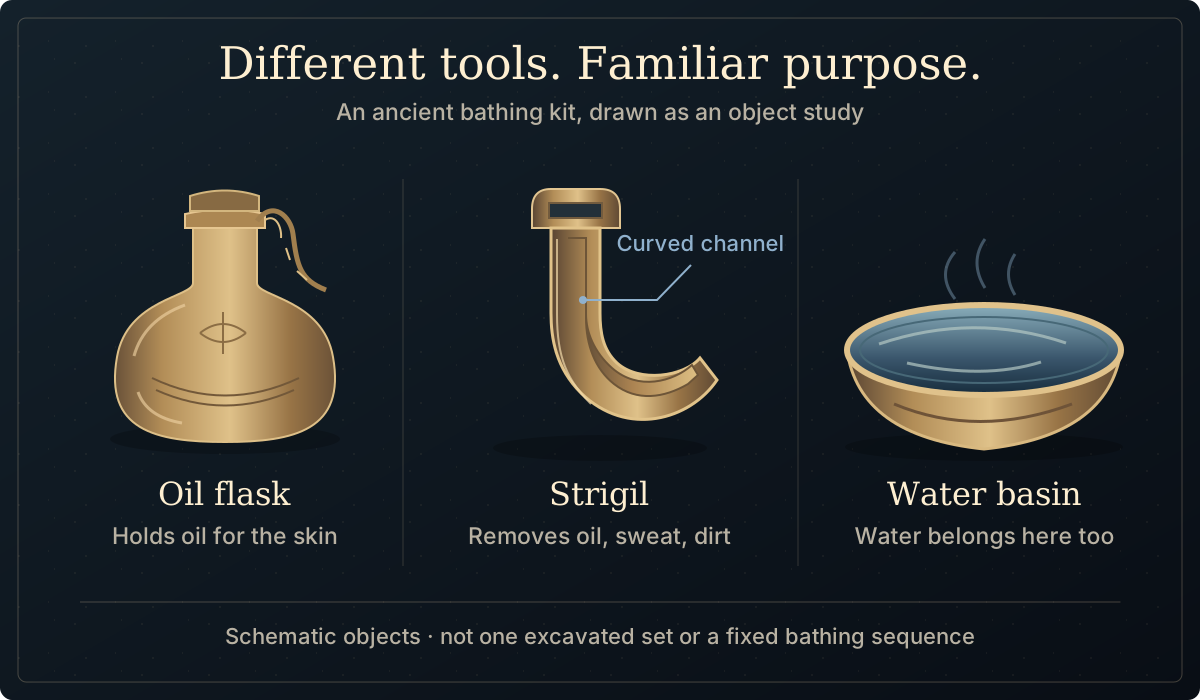
A strigil is a handled scraper with a curved working strip or channel. Oil applied to the skin could be removed with sweat and dirt by scraping. Think of a shaped cleaning tool, not a razor or a sharp sword being pressed into domestic service. The practice belongs to Greek, Etruscan, and Roman bathing traditions. [1]
The museum’s surviving Roman strigil and oil flask are imperial-period objects. They show the shape of the tool and the place of oil in bathing. They are later comparators for the soldiers’ Republican world.
Water belongs in this picture too. Oil and scraping did not mean avoiding baths; they were part of a broader cleaning culture that could include pools at different temperatures, exercise, and conversation. Cleaning could be part of a social occasion as well as a bodily necessity. [1]
A bath was also a place
Vitruvius’s architectural instructions show the practical thinking behind bathing. He places women’s and men’s heated rooms beside each other so that they can share a furnace. Warmth, light, water supply, and the number of users all require planning. His account is an architectural prescription from after Caesar’s lifetime, not a rule followed by every establishment. [2]
That larger setting matters to the novel’s domestic contrast. Four men accustomed to shared male space can meet a household bathroom and see an inefficient arrangement. Their host can see four additional people competing for the only quiet interval in her day. Both parties understand plumbing. The queue, and who has the right to insist on it, are another matter.
Did Romans know soap?
The tidy answer “no” is too tidy. Pliny mentions sapo, made from fat and ash, and associates it with Gallic invention and hair treatment among Germanic people. He distinguishes thick and liquid preparations. That is evidence for a substance and a use—not proof that every Roman routinely washed his whole body with a modern scented bar. [3]
Pliny writes in the first century AD, later than the soldiers’ 44 BC. Their encounter with Carla’s bathroom concerns a particular household’s products and habits. They arrive with preferences of their own; Maria arrives with rules. The lesson can begin with where something belongs and who has been using it.
Shared space did not abolish modesty
Cicero gives a Republican counterweight to the idea that Romans had no privacy. In On Duties 1.126–129 he discusses bodily discretion and says that grown sons do not bathe with their fathers, nor sons-in-law with fathers-in-law. This is a statement of propriety, not an exhaustive survey of Roman behavior. [4]
Boundaries existed; their form depended on the people, place, and occasion. Familiarity with communal bathing does not grant access to a woman’s private rooms. The comedy works best when the dispute is concrete: knock, wait for an answer, leave the cooking oil alone, and remember that the owner of the house also needs to wash.
KEEP EXPLORING
Sources & further reading
- University of Missouri Museum: Strigil and Oil Flask
Museum objects and curatorial explanation of oil, scraping, water, and bathing culture. The illustrated Roman objects are imperial-period comparators.
- Vitruvius, On Architecture 5.10
Architectural prescriptions for heated bathing rooms and their furnaces; written after the soldiers’ 44 BC setting.
- Pliny, Natural History 28.191
Latin primary passage on fat-and-ash sapo and hair treatment. Later than 44 BC and not evidence of universal Roman body-washing habits.
- Cicero, On Duties 1.126–129
Late-Republican discussion of bodily modesty, including restrictions within male family relationships. An ethical text, not a population survey.