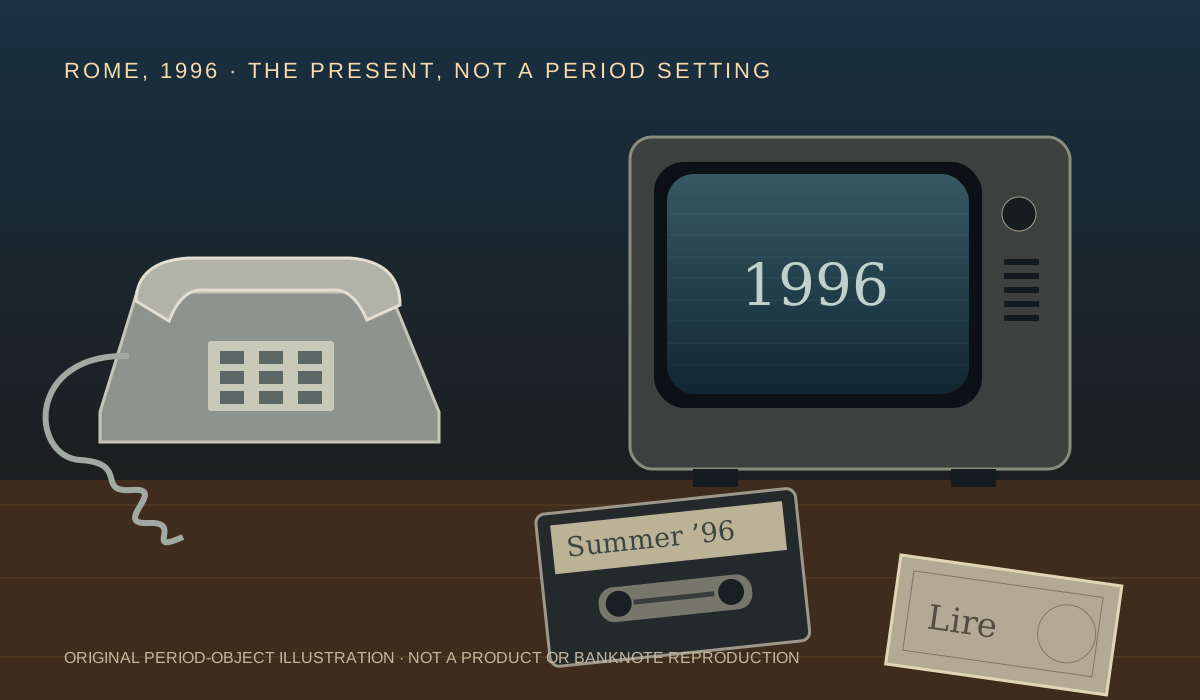
To Carla, this is the present, not a period setting. The keys, the radio, the change on the counter need no explanation. To the men she meets, even an ordinary Roman evening refuses to behave.
Money you can hold
Carla’s everyday cash is lire. Euro banknotes and coins would not arrive until January 2002; the euro’s noncash launch was January 1999. A coffee at the same corner café belongs to a different monetary world. [1]
Coins and bills also make exchange physical. Someone counts, waits, finds a smaller note, or gets change. For the soldiers, familiar acts survive beneath unfamiliar denominations. It is not the idea of money that needs explaining.
A telephone belongs somewhere
The villa’s telephone sits in the house. Calls can be answered by the wrong person, interrupted, or overheard. Carla cannot tuck the whole household’s connection to the outside world into her pocket.
Telecom Italia was created through a merger in July 1994. Mobile phones and the internet existed in 1996, but their existence did not make every person permanently reachable or every household instantly searchable. [2]
The sound of a summer
Carla’s musical life includes Mozart and the Italian dance sound of the period. Loving the music does not oblige her to love a crowded club. A piano phrase coming through a neighbor’s window can reach her without asking her to go anywhere.
Robert Miles’s “Children” entered the UK singles chart in January 1996, months before the book’s August opening. Its piano melody belongs to the summer’s musical landscape—and to Carla’s taste for dance music that can be wistful as well as propulsive. [3]
Music reaches rooms by radio, cassette, or a nearby listener’s choice. Its interruption can be as revealing as its arrival. A newsreader takes over; someone lowers the volume to hear the door. A few seconds of a familiar melody can give an ordinary room its place in time.
For music composed specifically for this world, listen to the original soundtrack. The period songs and the novel’s soundtrack do different jobs: one belongs to Carla’s surroundings, the other accompanies the reader’s experience.
A country arguing over its future
By late summer 1996, Romano Prodi’s first government was in office, succeeding the Dini government. Carla’s private emergency unfolds in a country arguing over authority, public life, and its future. [4]
Broken Arches puts modern Rome against an older measure of civilization: duty, family, craft, beauty, and authority answerable to something beyond appetite. A city can grow richer in conveniences while losing its sense of what it owes the next generation. The men bring that question into Carla’s house before anyone is ready to answer it.
A headline that was still a question
On August 7, NASA reported circumstantial evidence interpreted as possible ancient microscopic life in a Martian meteorite. The announcement offered a possibility, not proof. For an August reader, the excitement and the uncertainty arrived together. [5]
Even a summer headline could make the familiar universe larger and stranger. For a historian accustomed to weighing fragments of evidence, the gap between a startling possibility and an explanation she can defend is close to home.
The city is not a museum
Rome’s past is close enough to walk beside, but Carla has a present to live in. Her aunt can call. She has work to do. Traffic still has the right of way, whatever an inscription says.
Carla’s Rome is worth caring for: her aunt’s kitchen, a library full of work still to do, music through an open window, the pleasure of something made well. Helping the men puts those attachments at risk. Her encounter with the older Rome asks what she wants to preserve—and what she has learned to live without.
KEEP EXPLORING
Sources & further reading
- European Central Bank — Our Money
The euro’s accounting launch in 1999 and introduction of physical cash in 2002.
- TIM Historical Archive — Telecom Italia’s Creation in 1994
Telecom Italia’s creation through the July 1994 merger.
- Official Charts — Robert Miles, Children
“Children” entered the UK singles chart in January 1996.
- Camera dei Deputati — First Prodi Government
The Italian parliament’s historical government record.
- NASA — Early Microscopic Life on Mars?, August 7, 1996
A contemporary report of proposed evidence, not confirmed extraterrestrial life.