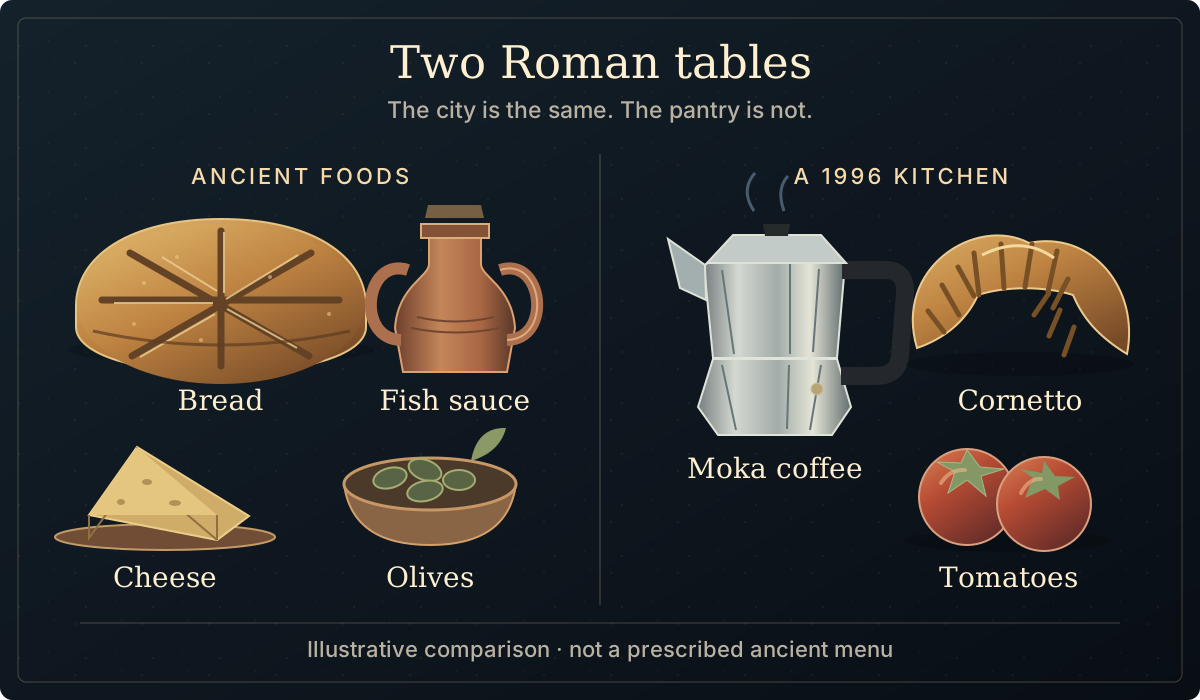
An aqueduct can announce the distance between two worlds. A breakfast can make that distance personal. Bread still looks like bread. The dark liquid in the small cup requires further investigation.
What would breakfast taste like?
Start with the familiar rather than a banquet of flamingo tongues. Herculaneum’s archaeological breakfast display brings together bread, figs, olives, and grain preparations, with water or light wine. These are foods a reader can picture in a hand, a bowl, or a hurried morning—not merely on a millionaire’s dining couch. [1]
The date matters. Herculaneum preserves evidence from the city destroyed in AD 79, more than a century after the soldiers’ departure. It gives us a later Roman table to compare with the soldiers’ Republican world. Availability, posting, money, and individual appetite all shape a meal: a camp breakfast and a comfortable household’s breakfast answer different needs.
Sweet baking is not a modern discovery
Cato’s Republican On Agriculture supplies firmer footing before 44 BC. His recipes include a cheese-and-flour loaf, a layered cheese-and-honey cake, and fried sweets finished with honey and poppy seeds. Ancient diners were not waiting two thousand years for someone to invent dessert. [2]
A cornetto can still be a revelation: its particular scent, yielding middle, and fragile browned surface are not Cato’s cake. Its pleasure reaches the men before the explanations do. The new world may still be a punishment, a deception, or a place they cannot leave; a warm pastry gives them a moment in which it is also generous. Publius can turn the contradiction into a joke without settling it.
The missing condiment
Garum is a fish sauce, not a tomato sauce. In Natural History 31.93–95, Pliny describes fish material treated with salt, prized mackerel sauce, and distinctions between the liquid and its residue. His account also makes room for expensive grades: the condiment could carry status as well as flavor. This is first-century AD testimony, not a surviving recipe from Caesar’s kitchen. [3]
Fish sauce therefore offers more than a joke about smell. It is an ordinary expectation that another household may fail to understand. Who asks for it? Who knows how to prepare it? Who thinks a perfectly good lunch needs nothing else? Small disagreements can reveal as much as a sword.
A kitchen that smells like 1996
Carla’s moka is ordinary household equipment in her own world. The Moka Express design dates to 1933; water in the lower chamber is driven through ground coffee into the upper chamber. That design had been part of Italian domestic life for decades by Carla’s August morning. [4]
Tomatoes make a sharper historical break. Pompeii’s archaeological park explicitly distinguishes its ancient bread still life from modern pizza: tomatoes are absent from that ancient food world. A red sauce can feel quintessentially Roman to Maria and be unfamiliar to men from the Republic. [5]
That is the pleasure of the contrast. The same city can offer a recognizable loaf and an unrecognizable cup. A guest can remain frightened, proud, or homesick while discovering that the new breakfast has its merits. Hospitality reaches the stomach before it resolves the larger questions.
KEEP EXPLORING
Sources & further reading
- Herculaneum Archaeological Park: Breakfast
Official archaeological display. The AD 79 context is comparative evidence, not a fixed 44 BC military menu.
- Cato, On Agriculture 74–86
Republican recipes; especially 75, 76, and 79. Recipes establish foods, not how frequently soldiers ate them.
- Pliny, Natural History 31.93–95
Latin primary text describing fish sauce and its grades. Pliny wrote in the first century AD, after the novel’s Republican setting.
- MoMA: Alfonso Bialetti’s Moka Express
Designed in 1933; the collection’s physical example was made in 2008. Used for design history, not as a period photograph.
- Pompeii Archaeological Park: The Regio IX Bread Still Life
Official explanation of the ancient painted foods and why the image does not show modern tomato-topped pizza.